From one node to Cortex: serving blockchain data at 100K TPS, globally
Author: Mihir Chitalia

What does it take to serve blockchain data at the lowest possible latency at 100K+ TPS—reliably, globally, and with perfect consistency?
That was the challenge we faced in early 2023 as we mapped out how to support the next wave of scaled blockchain apps, especially the ones onboarding millions of new users, like World App and Robinhood.
Our journey started in 2017 with a single Ethereum node. Since then, we’ve powered countless applications through bull markets, bear markets, and everything in between. All of that operational experience led to Cortex, the world’s first intelligent blockchain engine.
Today, Cortex powers our entire developer platform: RPC APIs, Data APIs, Gasless Transactions and Rollups. It’s a major leap forward for every Alchemy product. No migrations, no new tools to learn. Just smarter, faster infrastructure built on years of real-world lessons.
The road to Cortex
In the early days, our founders Nikil and Joe were building a blockchain research tool for hedge funds when they ran into the pain of running Ethereum nodes themselves. A single node worked until demand exploded during the 2017 ICO boom. Scaling horizontally helped with throughput, but it introduced a huge challenge: data consistency — ensuring every user saw the same canonical blockchain state, regardless of which node served their request.
To fix this, we built Vox Nodi in 2018, a consistency layer that guarantees identical blockchain state across nodes. By 2021, our Node APIs powered by Vox Nodi were serving teams like OpenSea, 0x, and Polymarket through massive traffic spikes.
Then came the multichain era. Starting in 2022, we expanded from a handful of EVM chains to more than 100 and launched support for Solana. At the same time, our newer products, such as NFT API, Token API, Transfers API, Smart Wallets, and Rollups as a Service became our most effective internal stress test. They are built on the same foundation and generate workloads larger than any of our customers, which has helped us anticipate scaling issues and harden our systems ahead of customers running into them.
But even with all these advancements, much of our infrastructure still lived in the US. Teams in Europe and Asia saw higher latency. To support a truly global, multichain ecosystem, we needed a full re-architecture: a completely new engine.
Cortex: speed + reliability, at global scale
By 2023, developers demanded two non-negotiables:
- Sub-50 ms global latency
- Unshakeable reliability, regardless of traffic spikes or underlying blockchain issues
Delivering both — with zero tradeoffs — required rethinking our entire stack from first principles. That became Cortex.
Since launch, we’ve continued optimizing the request path. Recently, we shipped one of our largest upgrades yet: Alchemy Edge Proxy, our in-house DDoS protection and routing layer. It replaces our last third-party dependency on the critical serving path, pushing latency even lower while improving reliability.
Speed: making every request faster
Every step of a request through Cortex is tuned for speed.
Global node placement ensures requests always land in the closest region, while real-time replication keeps every region up to date. With Vox Nodi as our consistency layer, expanding to multi-region required some clever adjustments, which ultimately allowed us to deliver a fast and consistent experience across the globe.
Replacing our third-party edge with Alchemy Edge Proxy had a huge impact. By bringing the edge in-house, routing happens closer to users with less overhead. The impact was immediate: P95 latency across RPC calls dropped 7.5×, from 150 ms to 20 ms.
For current public performance data, see Alchemy's RPC latency benchmarks across providers, chains, and regions.
Inside each data center, our core compute and networking layers take over, colocating dependent services and enforcing locality-aware routing. This means that requests don’t bounce unnecessarily between machines, cutting out wasted hops. Istio also strengthens our internal posture with mTLS by default and provides advanced traffic management features such as retries, circuit breakers, and gradual rollouts, all of which contribute to both speed and resilience.
Once a request reaches a node, single-machine performance becomes the bottleneck. By running on bare-metal servers, Cortex avoids the overhead of virtualization and gains tighter control over cost and latency. Our close collaboration with the team behind the Reth node client gave us upstream fixes and client-level optimizations that dramatically improved throughput.
Cortex also accelerates the very first moment data becomes available. At the network layer, we use predictive peer selection and quorum building to detect new blocks as early as possible. In practice, this means our users see fresh blocks and state updates sooner, which compounds downstream for latency-sensitive workloads like indexing, trading, and real-time applications.
Finally, Cortex routes requests intelligently based on network type, client type, latency profiles, SLAs, and historical patterns. Routing is managed through a GitOps-style workflow and propagates globally within seconds. Our proxies consume those same dynamic configs to adapt on the fly. For example, when migrating traffic to Reth-based clients, discrepancies in JSON RPC error codes were smoothed over by proxy modules that rewrote responses on the fly — while we simultaneously contributed permanent fixes upstream.
At every level, region, data center, node, Cortex is engineered to cut latency. That’s how it delivers sub-50 ms responses worldwide.
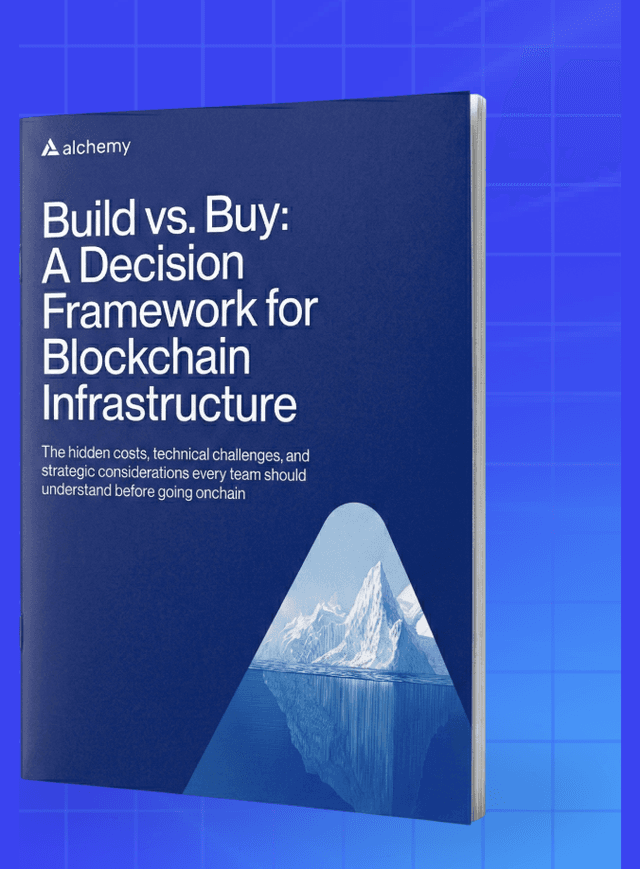
Build vs. Buy: Blockchain Infrastructure
Before you hire an infra team, read this: building in-house can cost $850K–$1M+ a year before you serve a single production request. See the full cost breakdown.
Reliability: defenses at every layer
But speed alone isn’t enough. Reliability is equally critical, and Cortex thoughtfully builds defenses into every layer of the stack.
At the edge, Alchemy Edge Proxy removed our third-party dependency from the critical serving path. By bringing this layer in-house, we have gained tighter reliability guarantees and eliminated an entire category of vendor-level outages. In fact, during the global Cloudflare outage on November 18, Alchemy’s services were largely unaffected — exactly the kind of reliability scenario Cortex is designed to withstand.
At the node service level, our proxies use a microkernel architecture. Each feature is a pluggable module that can be enabled, disabled, or reconfigured at runtime without redeploying the entire proxy. This design gives us the flexibility to patch bugs, normalize client behavior (for example, Reth vs Geth differences), and roll out new functionality without downtime. We pair this with shuffle sharding and redundant node pools, so failures are isolated and contained.
Within each region, Cortex automatically reroutes traffic to healthy nodes when one goes down. Versioned updates ensure developers never encounter stale reads, even under heavy failover conditions.
Globally, Cortex employs a multi-layered failover system. If the primary region is degraded, requests are routed to a secondary. If that fails, we fall back to a legacy stack. And in the rarest case, we maintain an isolated emergency backup stack. On top of this, real-time global replication ensures every region remains consistent during these transitions. Every request has multiple fallback paths before a developer ever sees an error.
Finally, Cortex introduces smarter systems to predict and prevent outages. Our AI-driven fleet management system monitors for node updates, analyzes their significance, and automates testing and upgrading nodes as required. And context-aware routing adapts dynamically to network congestion, degraded nodes, or buggy client versions, ensuring requests continue to succeed under shifting conditions.
This is why our reliability is industry-leading and enterprise-grade.
Cortex in the real world
Cortex powers 71% of the top crypto applications and is the foundation of Alchemy’s developer platform.
It processes $1T+ in onchain transactions annually and supports global leaders like JPMorgan, Visa, Robinhood, Polymarket, and Circle.
A few examples:
- Polymarket used Cortex during the 2024 U.S. elections, achieving ~100 ms global latency and zero downtime with direct-to-region routing.
- World Chain scaled to 30M+ users and ~598K new accounts per week while maintaining sub-50 ms latency.
- Usual reported dramatically faster performance and instant load times after migrating to Cortex, thanks to 2× faster infrastructure.
- JPMorgan’s JPM Coin uses Cortex-powered Alchemy Wallet Infrastructure.
- Robinhood, Stripe, Coinbase, and Visa all rely on Cortex for mission-critical performance.
Closing
So what does it take to serve blockchain data at 100K+ TPS, globally, with perfect consistency?
It takes Cortex — the first system to combine speed and reliability at scale, without tradeoffs. Built from 9+ years of iteration, lessons, and scale, Cortex now powers every part of the Alchemy platform.
Ready to experience Cortex?
You build the future, and we’ll handle the infrastructure.
Alchemy Newsletter
Be the first to know about releases
Sign up for our newsletter
Get the latest product updates and resources from Alchemy
By entering your email address, you agree to receive our marketing communications and product updates. You acknowledge that Alchemy processes the information we receive in accordance with our Privacy Notice. You can unsubscribe anytime.

Related articles
How to benchmark RPC providers for your workflow
Benchmark RPC providers on latency under load, block lag, and data consistency, measured separately, on the methods your app calls, from where it runs.
Solana Alpenglow: the biggest consensus overhaul in Solana's history
Alpenglow goes live on Solana mainnet October 21. What to expect, how Alchemy prepared, and what changes under the hood.
Solana gRPC performance: a public benchmark methodology
How we measure Solana gRPC delivery latency across six regions, with p50, p90 and p99 results, the full test setup, and the exact commands to reproduce them.