What are DeFi AI agents? Use cases, risks, and architecture

Written by Uttam Singh

For most of DeFi's history, software gave you advice and you did the work. A dashboard showed the best yield. A bot warned you when an arbitrage opened. You still opened a wallet and signed.
DeFi AI agents, often called DeFAI agents, change that relationship. They are autonomous systems that combine AI reasoning with DeFi execution: they read onchain data, choose an action, and sign or route transactions under predefined policies.
A DeFi AI agent is software that reasons, signs, and settles onchain.
The word "signs" is the one that matters. A bot that recommends a trade is a research tool you can ignore. A system that signs the trade is handling money. That is what makes DeFi AI agents powerful, and it is why most of the engineering work goes into stopping them from losing it.
What is an AI agent?
An AI agent is a language model wired to tools, memory, and a policy. The model handles intent: what the user wants. The tools handle execution: fetch this data, call this API, send this transaction. The memory preserves state across turns so the agent does not relearn the user's preferences on every prompt. The policy decides what the agent can do without asking again.
That loop is similar whether the agent is writing code, booking flights, or managing a portfolio. The infrastructure usually includes a planner model, a tool layer for action discovery, a wallet or credential store, and a policy layer that bounds the agent's authority.
The difference in DeFi is that the action can move money.
What is a DeFi AI agent?
A DeFi AI agent is an AI agent operating inside decentralized finance. Its tools are DeFi actions: swapping tokens, lending assets, staking, bridging funds, checking balances, or moving liquidity between protocols.
The sharp line is execution. Some systems only recommend actions or prepare transactions for a human to approve. Those are copilots or agent-assisted workflows. A fully autonomous DeFi AI agent can sign or submit transactions itself, within rules the developer or user sets in advance.
That creates the core design tension: an agent is useful when it can act on its own, and safe only when it cannot act too freely.
What can DeFi AI agents do?
The first DeFi AI agents are not magic portfolio managers. They are narrow systems with clear jobs, bounded wallets, and explicit limits. The best use cases are repetitive, data-heavy, and sensitive to timing.
Stablecoin yield optimization
A stablecoin yield agent watches lending markets, estimates net returns after gas and bridge costs, and moves funds when another market pays enough more to justify the switch.
The agent itself can be simple. What matters is everything around it: limits on what it can touch, simulations before each move, and an approved list of protocols where it can send funds.
Lending and vault rebalancing
A lending agent can work inside a protocol like Morpho and keep funds in markets that match a user's risk and yield preferences. It can compare rates, watch liquidity, and shift positions when better pools open.
The safety model is not "let the agent chase the highest number." It is "let the agent move only between pools an expert has already approved."
Natural-language DeFi execution
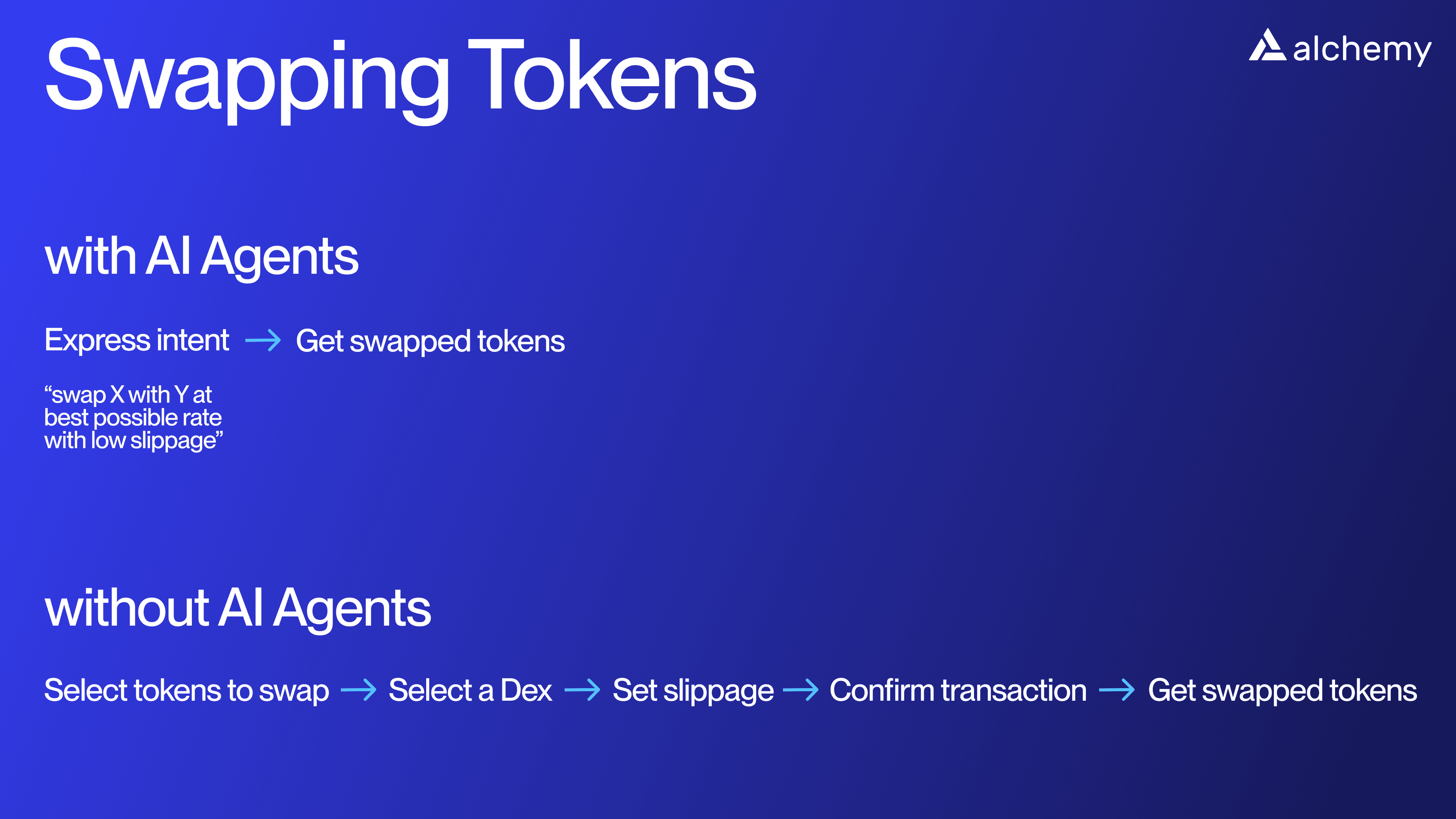
This is the version most users will recognize: a chat box. A user writes, "swap 500 USDC to SOL on the cheapest route and stake it," and the agent turns that request into a sequence of signed transactions.
The hard part is hidden. The agent has to find a route, cap slippage, check balances, simulate the transaction, and ask for approval when the request exceeds policy. The user sees one sentence. The system sees a workflow.
For a practical build path, our Solana AI agent guide walks through a chain-specific agent architecture end to end.
Social-native trading agents
Some agents live where users already issue commands: Telegram, Discord, or X. Bankr is one example of this pattern. The user sends a short instruction, and the agent handles routing, execution, and transaction feedback.
The same convenience creates a harder security problem. If the command surface is an inbox, the system has to defend against impersonation, malicious links, and prompt injection inside the same place users interact.
Treasury and DAO rebalancing
A treasury agent can monitor a DAO or fund balance, spread assets across stablecoins and yield positions, and rebalance as conditions change.
This is the hardest job to hand an agent because the amounts can be large and the downside can be immediate. A practical rule is to let the agent handle routine moves and require human approval for anything large, unusual, or outside a preset mandate.
These use cases share one structural property: the agent should not hold an unlimited master key. The policy that constrains it should be enforced both offchain at the signer and onchain in the wallet or account system.
What are the risks of DeFi AI agents?
Most DeFi AI agent risk comes from two places: the model can be manipulated, or the signing system around it can be compromised.
Prompt injection and context manipulation
Freysa was not a DeFi protocol, but it is a useful warning. The game gave an AI agent one instruction: never release the prize pool. After many failed attempts, one user found a prompt that convinced the agent it was allowed to send the funds.
The lesson applies directly to DeFi. An agent reads context, and attackers can hide instructions inside that context: chat messages, web pages, webhooks, token metadata, or price feeds. If raw text can trigger a payment directly, the wallet is downstream of untrusted input.
The fix is separation. The model can propose an action. A separate policy check decides whether that action can be signed.
Wallet and key compromise
The other failure mode is less exotic. The agent works as designed, but the key management around it is weak. If a private key sits in a plain .env file, or one stolen dashboard credential can approve unlimited spending, then a single compromise can drain everything the agent controls.
The AI did not fail. The locks around it did.
A DeFi AI agent's wallet should be treated like a production financial system: no raw keys in the agent loop, no unlimited spend authority, and no single approval point for high-value actions.
Bad objectives and missing limits
Even when the model and wallet are secure, an agent can still optimize the wrong thing. "Maximize yield" can push funds into fragile pools. "Find the best price" can ignore execution risk. "Rebalance every hour" can spend more on fees than it earns.
The safest agents translate broad user goals into narrow operating rules: allowed protocols, maximum position size, slippage caps, daily spend limits, and escalation thresholds.
What does the architecture of a DeFi AI agent look like?
Production DeFi AI agents usually have five layers. The exact tools vary, but the shape is stable.
Reasoning layer
This is the model that reads the goal and decides what should happen next.
The pattern that holds up best is to separate planning from execution. One step creates the plan: move funds, swap assets, rebalance a vault. A second step turns that plan into exact calls and transaction parameters. Splitting those steps makes the system easier to inspect before anything is signed.
Tool and data layer
Agents need clean access to balances, prices, transaction history, contract state, and protocol metadata. They can get that through RPC calls, indexed data APIs, webhooks, WebSockets, gRPC streams, and agent-native tool interfaces.
The Alchemy MCP Server exposes 168 tools through the Model Context Protocol across ENS resolution, token prices, NFT metadata, transaction history, smart contract simulation, tracing, account abstraction, wallet sessions, Solana DAS, and more. It covers 100+ networks and connects to supported MCP clients through a hosted OAuth flow.
That makes MCP useful for reads and discovery. For writes, the signing path still needs a separate custody and policy model. Connect the hosted server once, then ask for live prices, balances, and portfolio state without writing a script:
Custody and wallet layer
This is the most important design decision. The wrong pattern is to let the agent hold a raw private key. Anyone who extracts the key owns the funds.
Safer patterns keep the key outside the agent process. Embedded wallet and custody providers such as Privy and Turnkey can hold keys and enforce policy before signing.
The agent wallet feature in the Alchemy CLI uses this pattern for developer agents. When you run alchemy wallet connect, the dashboard creates or selects the wallet, the CLI receives a scoped and time-bound session, and the wallet private key stays with Privy. You can revoke the session from the dashboard.
That is how an agent moves from reading DeFi state to executing under limits you set. In this demo, Claude finds a market, bridges USDC, and deposits through a scoped CLI session, with the private key never leaving custody:
Policy layer
A safe agent has overlapping controls. Each one catches a different class of mistake.
- Simulate transactions before signing them.
- Limit the protocols and contracts the agent can call.
- Set maximum spend per transaction and per day.
- Expire permissions after a fixed time.
- Require human approval for unusual or high-value actions.
- Enforce rules at the wallet or account layer, not only inside the model prompt.
These controls overlap on purpose. The agent can be wrong. The wallet should still be able to say no.
Settlement and execution layer
Execution is where plans become transactions.
For swaps and routing, agents can use DEX aggregators such as 1inch, CoW Swap, or Jupiter on Solana. For intent-based flows, solvers compete to fill a signed user intent. For gas, a paymaster can sponsor transaction fees through products like Gas Manager, so the agent does not need to manage native tokens for every chain.
Offchain payments are a separate problem. Agents also need to pay for APIs, data, inference, and compute. Protocols like x402 let a server respond with HTTP 402 payment terms, then let the agent pay and retry the request. MPP extends the same 402 pattern with payment-method-agnostic rails, sessions, MCP transport support, and standardized primitives such as idempotency and replay protection.
For agent builders, the architecture is not one product. It is the combination of a wallet, a policy layer, a data feed, and a payment rail.
How does Alchemy support DeFi AI agents?
We ship the read, write, and payment surfaces a DeFi AI agent needs.
On the read side, agents can use RPC across 100+ chains, the Data API for token, NFT, portfolio, and price endpoints, webhooks, WebSocket subscriptions, Solana gRPC streaming, and the Alchemy MCP Server. With MCP, agents can query live on-chain data in natural language and interpret complex wallet, token, and transaction state across networks.
On the write side, the Alchemy CLI gives developer agents a scriptable terminal surface. Agent Wallets let you approve scoped signing sessions through the dashboard without handing the agent a raw private key. Create an agent wallet in the dashboard, run alchemy wallet connect, and sign from the approved session.
npm i -g @alchemy/cli@latest
alchemy auth
alchemy wallet connect
For agentic payments, Alchemy supports x402-paid access to Core RPC, NFT, Portfolio, and Prices APIs. The agent authenticates with its wallet, receives a 402 response when payment is required, pays in USDC, and receives the data without a human provisioning an API key for that request.
For coding agents, Alchemy Skills, the Alchemy CLI, and MCP give tools like Cursor, Claude Code, and Codex machine-readable ways to discover and call Alchemy primitives. That matters because agents should not have to reverse-engineer human documentation before they can build.
Install Alchemy Skills:
npx skills add alchemyplatform/skills --yesConnect the hosted MCP server. For Cursor or Claude Desktop, add this to your MCP config:
{
"mcpServers": {
  "alchemy": {
    "type": "streamable-http",
    "url": "https://mcp.alchemy.com/mcp"
  }
}
}
In VS Code Copilot, add this to .vscode/mcp.json:
{
"servers": {
  "alchemy": {
    "type": "http",
    "url": "https://mcp.alchemy.com/mcp"
  }
}
}
If you are building a DeFi AI agent, start with three primitives: a scoped wallet, a real-time data feed, and a payment rail. The model decides what to do. Those primitives determine whether it can act safely.
Frequently asked questions
What are DeFi AI agents?
DeFi AI agents are autonomous systems that combine AI reasoning with decentralized finance execution. They can read onchain data, choose an action, and sign or route transactions under policy controls. The most capable DeFi AI agents reason, sign, and settle onchain.
What does DeFAI mean?
DeFAI is shorthand for the intersection of DeFi and AI. The term usually refers to AI agents, copilots, and automation systems that help users trade, lend, rebalance, or manage assets across decentralized finance protocols.
How are DeFi AI agents different from trading bots?
Trading bots usually follow predefined rules. DeFi AI agents can interpret natural-language intent, use tools, reason over changing context, and choose from multiple actions. The practical difference is flexibility: an agent can decide how to pursue a goal, while a bot usually executes a fixed strategy.
Are DeFi AI agents safe?
They can be safe only if the wallet and policy model are designed carefully. A safe agent should not hold a raw private key, should operate under spending limits, should simulate transactions before execution, and should require approval for unusual or high-value actions.
What can DeFi AI agents do today?
DeFi AI agents can monitor markets, compare lending rates, rebalance vaults, route swaps, react to onchain events, and automate narrow treasury workflows. The best current use cases are bounded and repetitive rather than open-ended control of large portfolios.
What infrastructure do DeFi AI agents need?
They need a wallet or signing system, onchain data access, policy controls, transaction execution, and often a payment rail for API calls. Common infrastructure includes RPC, indexed APIs, webhooks, WebSockets, gRPC, MCP tools, scoped wallets, paymasters, and x402 payments.
Can DeFi AI agents pay for APIs?
Yes. Protocols like x402 let agents pay for API calls through the HTTP 402 payment flow. The agent requests a resource, receives payment terms, signs a payment with its wallet, and retries the request with proof of payment.
How do I build a DeFi AI agent with Alchemy?
Start with the Alchemy CLI for wallet setup, the Alchemy MCP Server or APIs for data access, and x402 for agentic payments. Install the CLI with npm i -g @alchemy/cli@latest, run alchemy auth, then use alchemy wallet connect to create a scoped signing session for your agent.
Related Overviews
 Infra
InfraSeptember 10, 2026
Best blockchain APIs for building autonomous onchain agents
A comparison of the top blockchain API providers for autonomous onchain agents, covering agent-native features, chain coverage, and the capabilities that matter when your user is a machine.
 Solana
September 30, 2026
The 14 best Solana wallets (2026)
Compare 14 top Solana wallets in 2026. Secure SOL storage for DeFi, NFTs, and staking. Hardware, mobile, and browser.
 Blockchain
September 25, 2026
EVM vs SVM: a developer's guide
A developer comparison of the EVM and SVM covering account models, parallel execution, fees, program design, and migration, with code examples.

Build blockchain magic
Alchemy combines the most powerful web3 developer products and tools with resources, community and legendary support.