The ultimate guide to embedded wallets with social login

Written by Alchemy Team
Social login lives in the signer: an embedded wallet provider such as Privy or Turnkey handles Google, Apple, email, and passkey sign-in and holds the keys. Alchemy's Wallet APIs sit on top as the transaction layer, sponsoring gas, batching calls, and upgrading those embedded wallets to smart wallets through EIP-7702.
Embedded Web3 wallets are crypto wallets built directly into applications, eliminating the need for your users to download wallets separately while maintaining non-custodial security. Wallets are the gateway to crypto, and in 2025, providing frictionless onboarding experiences is essential to onboarding mainstream users.
And with smart wallet usage on the rise, embedded wallets present a significant opportunity to improve user experience and increase adoption rates.
Whether you're new to embedded wallets or exploring your wallet strategy, this comprehensive guide will help you choose the right wallet-as-a-service provider, implement secure social login wallets, and build future-proof applications that onboard your users seamlessly.
Embedded wallets explained
How do embedded wallets differ from traditional wallets?
Traditional web3 wallets are standalone applications users download separately, while embedded wallets integrate directly into host applications. This fundamental difference transforms the user experience from a multi-step process to seamless onboarding.
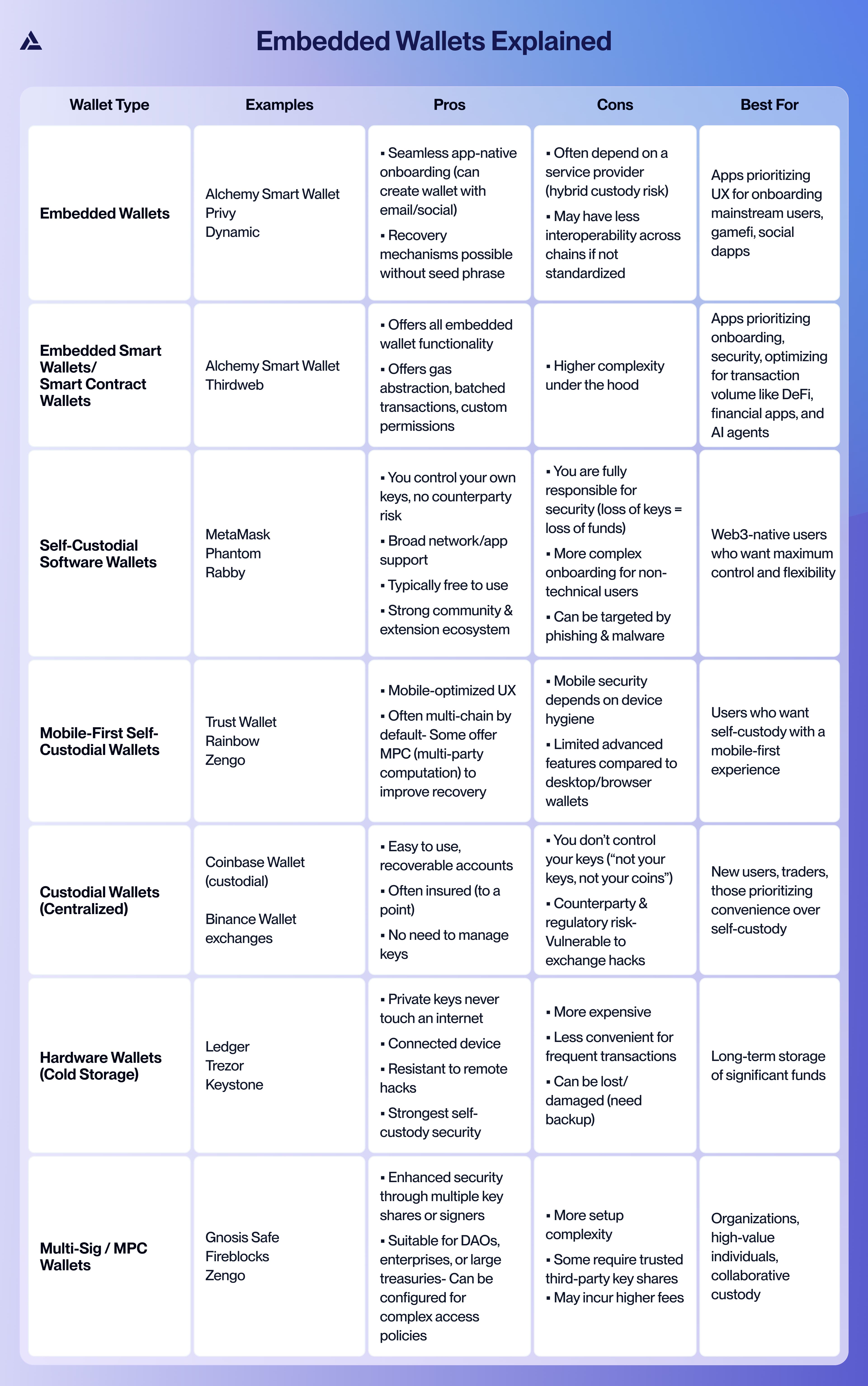
Key embedded wallets terminology
Here are three key terms commonly associated with embedded wallets:
Wallet-as-a-Service (WaaS)
Cloud-based infrastructure that lets you create and manage wallets for your users via APIs without handling key management yourself. This eliminates the complexity of cryptographic operations while providing enterprise-grade security and compliance features.
Multi-Party Computation (MPC)
A cryptographic technique that splits a private key among multiple parties, eliminating any single point of failure. With MPC, users maintain control over their assets without ever exposing their complete private key to any single entity, including the wallet provider.
Account Abstraction
Ethereum Improvement Proposal ERC-4337, deployed in March 2023, enables programmable accounts that can use custom authentication methods and transaction logic. Account abstraction allows features like gas sponsorship, transaction batching, social recovery, and flexible authentication beyond traditional private key signatures.
These technologies are commonly used in embedded wallet solutions, each addressing different aspects of the user experience and security model.
Real world use cases for embedded wallets
Embedded wallets have gained significant traction across different industries, with smart wallet implementations (embedded wallets enhanced with account abstraction) driving the most compelling use cases:
- DeFi platforms: Embedded wallets eliminate the need for users to download separate wallet apps before trading. Recent data shows 33M swap transactions occurred through embedded wallets in May 2025, processing $9B in volume. While social login provides instant access, smart wallet features like gas sponsorship and transaction batching are increasingly driving adoption.
- Onchain games: Gamers can start playing immediately using Discord or Steam credentials through embedded wallet integration. Smart wallet capabilities enable gasless NFT transactions and one-click purchases, removing both onboarding and ongoing friction that previously prevented mainstream gaming adoption.
- Cross-border payments: Users authenticate via familiar methods like email, phone number, or existing auth systems through embedded wallets. Smart wallet enhancements enable features like automatic gas optimization and transaction bundling.
As embedded wallet solutions mature, smart wallet implementations are becoming the preferred choice for applications requiring both simplified onboarding and sophisticated transaction capabilities across payroll platforms, loyalty programs, and identity systems.
Why embedded wallets are a game changer
Reducing onboarding friction for mainstream users
In the world of web2, social login (where users can create an account by logging in via their Google or Apple account) can boost onboarding conversion rates by 20-60%, and that’s just by replacing an email + password field with a single-click onboarding flow.
Imagine how much conversion rates for crypto apps improve when you don’t require users to handle the cognitive burden of understanding private keys, seed phrases, and backup procedures during their initial onboarding.
Embedded wallets enable social login (like logging in with email or phone numbers) to handle just that, and reduce wallet setup time from 5-10 minutes to 5-10 seconds.
Balancing convenience with self-custody
Different wallet custody models offer varying trade-offs between convenience and control:
- Custodial models: In this model, a 3rd-party custodian handles the user’s assets. It offers maximum convenience, but users don't control their private keys, undermining the value proposition of crypto. This is suitable for small amounts of money and new users who prioritize simplicity over sovereignty, but you will turn off some users who want to move in size with a custodial solution.
- Self-custodial wallets: This solution offers complete user control with seed phrase management. This model is ideal for experienced users with large holdings, but it creates onboarding friction and introduces a lot of complexity for new users.
Multi-factor authentication, passkey enhancements, and private key recovery
Developers can implement additional security layers to enhance social login protection via embedded wallets, such as:
- Email + OTP verification: Two-factor authentication using time-based codes sent to verified email addresses, preventing unauthorized access even if social accounts are compromised.
- Device-bound passkeys (WebAuthN): Biometric authentication tied to specific devices using FIDO2 standards, creating hardware-level security without requiring users to manage additional recovery phrases.
- Recovery phrase escrow: Optional encrypted backup of recovery information stored across multiple secure locations, enabling traditional seed phrase recovery while maintaining social login convenience.
Passkey adoption is accelerating with 2025 iOS and Android releases including native WebAuthN support, making biometric wallet authentication mainstream across mobile platforms. And with embedded wallets, we are seeing that same level of security sophistication coming onchain.
How to evaluate embedded wallet providers
There are 10 essential features when evaluating an embedded wallet provider.
Essential features checklist
- Multichain support: It’s not enough to be EVM-compatible anymore. Does the wallet support Solana and other emerging ecosystems?
- Social login: Does the tool offer native integration with popular platforms like Google, Apple, Discord, Twitter, and email/SMS authentication?
- Custody model: Does the provider offer non-custodial or custodial key management?
- Gas abstraction: Does the tool offer a paymaster that supports gasless transactions for your users and a frictionless UX?
- Analytics dashboard: Does the provider offer real-time monitoring of wallet creation, transaction volume, and user engagement metrics?
- Regulatory tooling: Does the provider offer any built-in KYC/AML workflows and compliance reporting capabilities?
- Account abstraction ready: Is the solution fully ERC-4337 compatible for programmable wallet features?
- Mobile SDK support: Does the provider offer native iOS and Android libraries with React Native compatibility?
- Recovery options: Does the tool offer multiple backup mechanisms for your users, including social recovery and encrypted cloud storage?
- Enterprise SLAs: How reliable is the provider? Can they guarantee 4 9s of uptime? What is their incident response time?
As you consider different providers, you want to consider the full feature set of the wallet stack provider. Social login is table stakes these days, and these providers can offer a lot more under the hood to onboard and activate your users.
Comparing wallet providers and infrastructure (Privy, Fireblocks, Coinbase, Alchemy)
When evaluating leading embedded wallet providers such as Privy, Fireblocks, and Coinbase, each offers distinct approaches and strengths.
We don't offer social login or key management ourselves. Pick a wallet provider such as Privy or Turnkey for that layer, then pair it with our Wallet APIs for everything that happens after sign-in.
Wallet APIs are signer-agnostic. Your provider's wallet signs, and we prepare the calls, sponsor gas, batch transactions, and upgrade the wallet to a smart wallet through EIP-7702 so it gets session keys and gas sponsorship without a new address. Privy is the recommended integration, and any viem-compatible signer works through a custom integration. Signers that can't sign EIP-7702 authorizations use a separate smart wallet address instead.
Implementation checklist to add social login to your onchain app
Interested in reducing onboarding friction with embedded wallets? Start by choosing a wallet provider such as Privy and the chain infrastructure your app needs.
-
Choose Provider & Obtain API Keys: Evaluate wallet providers based on your specific requirements, register for a developer account, and obtain production API credentials with appropriate rate limits.
-
Create an Alchemy app and API key: Set up your application in the Alchemy dashboard. The same key covers Wallet APIs and RPC.
-
Configure Gas Sponsorship: Create a gas sponsorship policy that defines which transactions you cover and how much your app spends.
-
Connect your signer to Wallet APIs: Follow the Privy guide or the custom signer guide so your provider's wallet signs and Wallet APIs send, sponsor, and track each transaction.
-
Implement Backup & Recovery: Enable social recovery mechanisms, set up encrypted cloud backups, and provide users with optional seed phrase exports for self-custody migration.
-
Add API Keys to Application Code: Initialize your wallet provider's SDK, then pass its signer to the Wallet APIs client along with your gas sponsorship policy ID.
-
Go Live and Monitor: Deploy to production with gradual user rollout, implement error tracking and analytics, and monitor wallet creation rates and transaction success metrics.
The Wallet APIs quickstart sends a first gasless transaction in a few minutes.
Bringing Web2 UX onchain
Embedded Web3 wallets with social login represent the future of mainstream crypto adoption, eliminating traditional onboarding friction while maintaining non-custodial security. The combination of in-app UX, social recovery mechanisms, enhanced with smart wallet features creates user experiences that rival traditional Web2 applications. As the ecosystem matures in 2025, developers who implement embedded wallet solutions early will capture users who would otherwise abandon complex Web3 onboarding flows.
Ready to build? Use a wallet provider such as Privy for social login and keys, and pair it with our Wallet APIs for gasless transactions and smart wallet features. See how Alchemy and Privy partner on onchain finance.
Frequently asked questions
Are embedded wallets custodial or non-custodial?
Most embedded wallets are non-custodial despite feeling custodial to users. They use Multi-Party Computation (MPC) or account abstraction to cryptographically split private keys across multiple parties, ensuring no single entity can access user funds. That way users maintain full control of their assets while enjoying a simple social login experience. The exact custody and recovery model depends on the wallet provider and configuration you choose.
How does social login affect wallet security?
Social login streamlines the complexities of crypto that cause many casual users to abandon apps during onboarding, but does so without compromising the security of the wallet itself. When combined with MPC key sharding and multi-factor authentication, social login creates a familiar Web2 login experience with the security of Web3. Embedded wallets distribute cryptographic risk across multiple secure parties while providing multiple authentication factors, reducing single points of failure compared to seed phrase-only wallets.
Can embedded wallets support multiple blockchain networks?
Yes, depending on the provider, embedded wallets can support 50+ different blockchain networks including Ethereum, Solana, L2s, and more, all through a single SDK integration. Multichain support enables seamless interaction across different blockchain ecosystems without managing separate wallets for each ecosystem, simplifying the user experience and how many different wallet providers you need to support.
What happens if users lose access to their social accounts?
Embedded wallets offer multiple recovery mechanisms that prevent users from permanently losing access to their wallet. Social recovery allows designated trusted contacts to help restore access through cryptographic verification, and encrypted cloud backups and recovery email systems offer alternative paths to recovery.
How long does embedded wallet integration take?
Embedded wallet integration time varies by provider and application requirements, though a basic implementation with modern SDKs can take a few hours. The process involves integrating your wallet provider's SDK, configuring social login and recovery, and connecting the wallet to chain support and infrastructure for features like gas sponsorship and transaction bundling.
Do embedded wallets require KYC compliance?
Embedded wallets themselves don’t “require” KYC or any particular form of user identification. The user information you need for regulatory purposes is entirely dependent on the jurisdiction of your business, and that of your customers. However, integrating support for features like fiat on/off ramps may increase your compliance burden. Review your requirements with qualified legal counsel and confirm what compliance controls your wallet provider supports.
Related Overviews
 Wallets
September 2, 2026
Agent wallets: the session and permission model for AI agents
How AI agents get scoped, revocable wallet access without holding private keys: sessions, delegated signing, and instant revocation.
 Wallets
July 29, 2026
Stop pasting private keys into Cursor: how to give your coding agent a wallet
Give your coding agent a wallet without giving it the key. How Alchemy CLI agent wallets use scoped sessions so agents can transact without private keys in .env.
 Wallets
June 24, 2026
What is a crypto bundler?
A crypto bundler combines multiple transactions or operations into one onchain submission across batching, MEV, rollups, token launches, and account abstraction.

Build blockchain magic
Alchemy combines the most powerful web3 developer products and tools with resources, community and legendary support.